
By Benjamin Schwarz | October 2026. First published on Substack.
Artwork by Hafsa Mumtaz
This is a personal essay, drawing on Greening of Streaming (GoS) measurements, not an official GoS position. Some of the results are preliminary, as noted below.
I’ve spent much of the last two and a half decades around video compression. Each codec generation squeezes more picture into fewer bits, and as an industry we have become extraordinarily good at it. Since I started measuring what streaming consumes at the mains electricity plug, I’ve been wondering whether we’re looking at the right end of the chain.
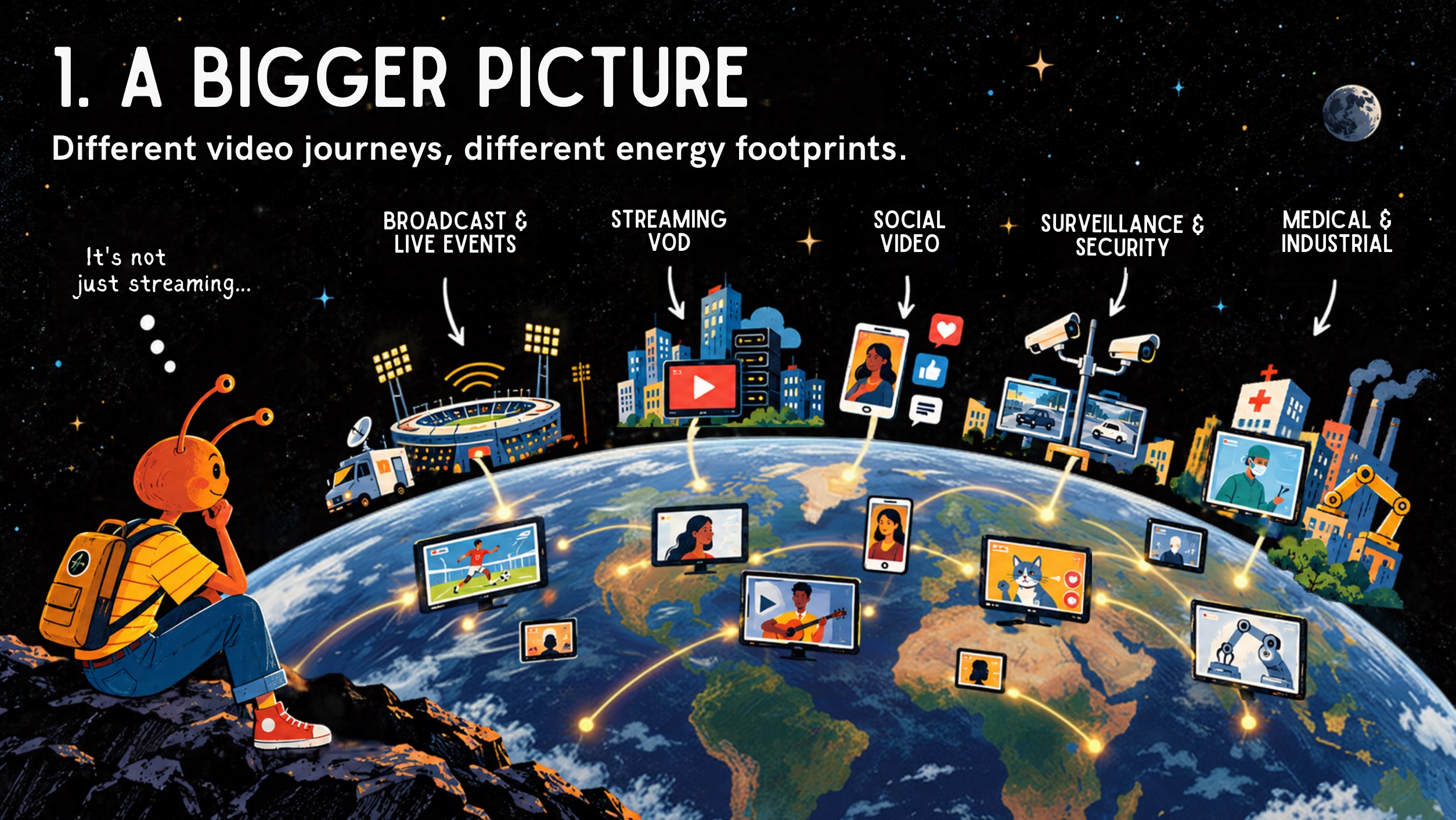
Look at our industry from Mars. You would see a great deal of engineering devoted to creating, compressing, and shipping video. You would also see billions of screens lit for hours every day. A popular title might be encoded dozens of times, but decoded millions of times.
But our Martian would also see the other extreme of barely watched video: surveillance cameras recording around the clock, medical and industrial archives, enterprise recordings, and live streams with audiences you could count on one hand. There, encoding and storage can loom much larger than decoding.
The Martian and I are both unsure of the real ratio at planetary scale. Deciding where GoS should look first keeps me up at night. So we started measuring.
Most of what we obsess over, the decoder ignores
OWL is Greening of Streaming’s open measurement platform. We took one video, encoded it many different ways (different encoders, keyframe intervals, B-frames, even codecs) and measured the electricity five streaming devices drew playing each version.
Upstream, the choices mattered a lot. In one comparison, software encoding used 3.4 times as much electricity as GPU encoding. Downstream, nothing measurable. On hardware decoders, playback power didn’t move beyond our measurement uncertainty. We can spend more than three times the energy to make a bitstream without measurably changing the electricity the box under the TV consumes while playing it.
What the box does notice is whether it has the silicon for the codec. A 2017 Apple TV playing AV1 in software drew about 1.2 W more, or 29%, than when playing video using hardware decoding. Another device valiantly accepted the stream but managed just three frames per second, which is not exactly a triumph of compression efficiency. The codec that compresses best is not automatically the one that costs least to watch.
Except when it notices
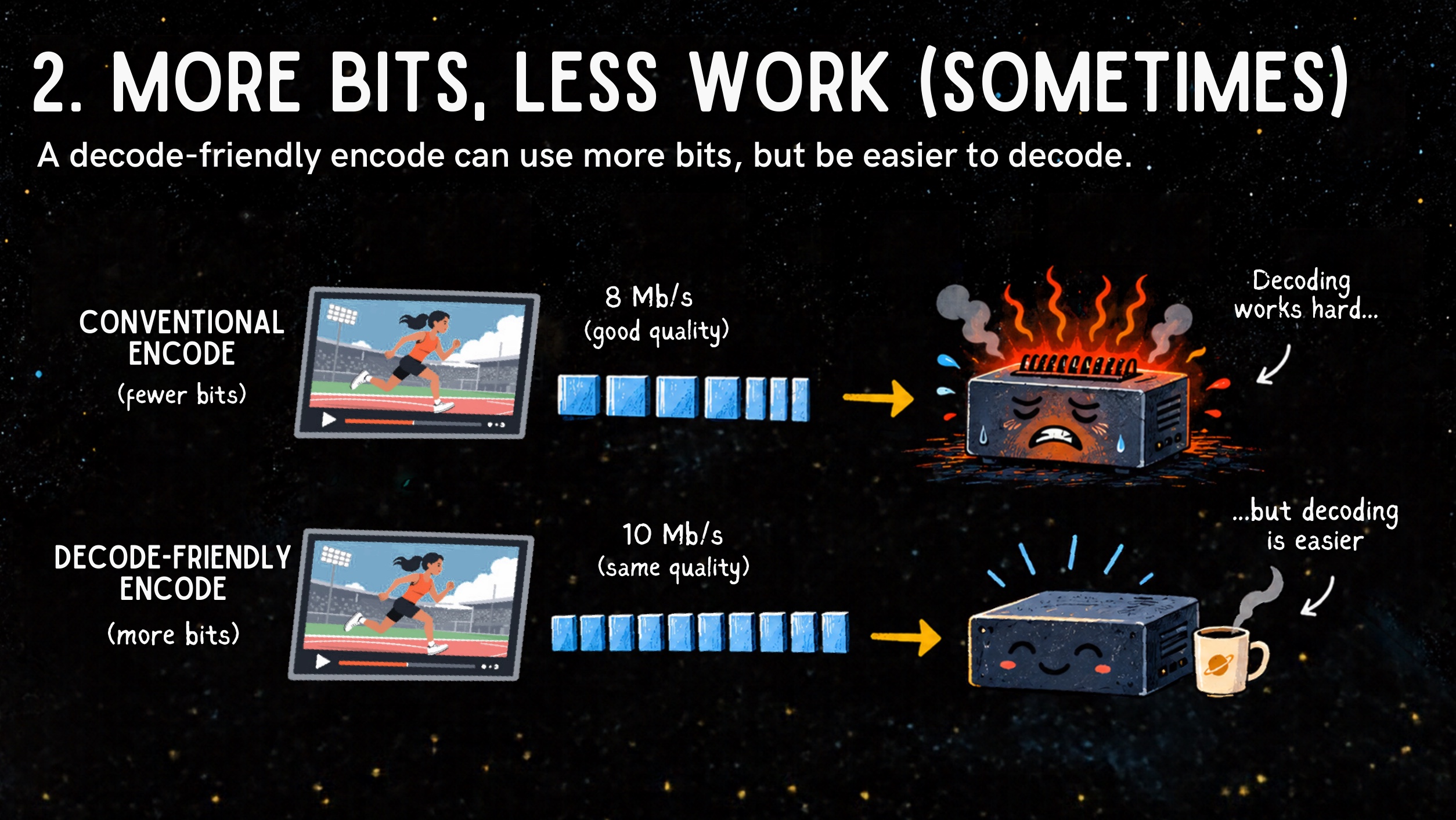
Of course, there are counterexamples. We encoded the same H.264 video twice: once conventionally, once with x264’s fastdecode option, which avoids some of the tools that make a decoder work hardest. At an equivalent measured quality (using Netflix’s VMAF), the decode-friendly version required 25% higher bitrate. By our industry standards, that’s a pretty poor result for compression efficiency.
Encoding it cost no more energy: about 1.13 Wh for the two-minute clip either way. But on a Raspberry Pi 5, which decodes in software, it cut decoding power by 40%. Careful: that’s 40% of the decoding increment (0.60 ± 0.24 W), not 40% of what the whole device consumes. The price is paid entirely in bits, which still have to be stored and carried, so I can’t tell you whether the system as a whole comes out ahead.
But the direction is what interests me. Sometimes spending more bits saves electricity. The best encode depends on who’s going to watch it, and on what.
The elephant in the living room
This all matters when you need to scale. Picture a World Cup final watched on a billion screens for three hours. One watt saved per screen is 3 GWh: enough to run my streaming box nonstop for about 190,000 years, or one of the new gigawatt AI data centres coming online this year for three hours. That’s just arithmetic, not a finding: there is no universal watt, and the world doesn’t watch on a billion identical viewing devices. But it shows why a decision made once upstream deserves a look at what it does, a billion times over, downstream.
And while we chase fractions of a watt in the decoder, something rather obvious sits at the other end of the HDMI cable.
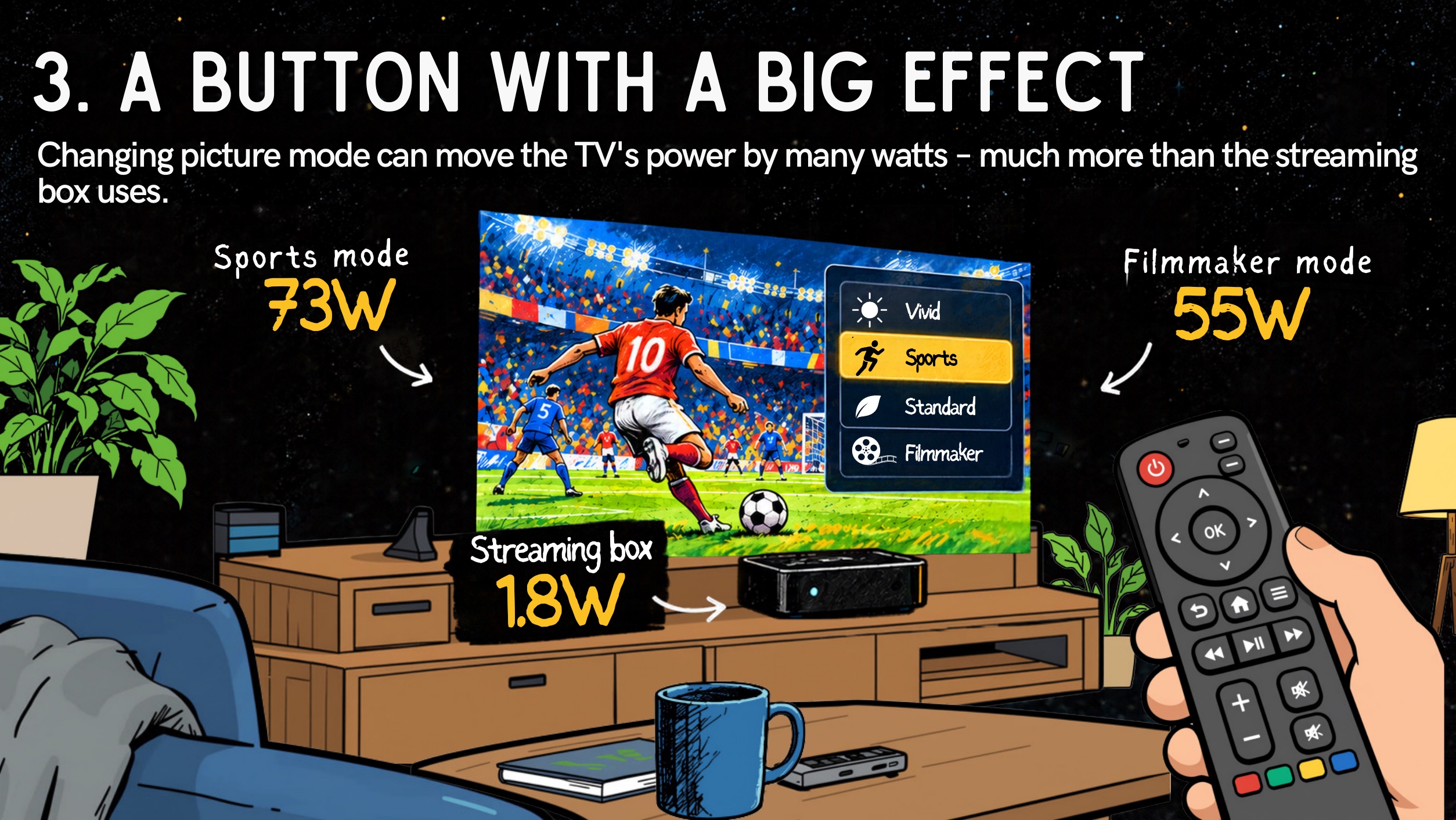
We measured our 55-inch LG OLED showing the same material in two picture modes. Two minutes of real adverts: about 49 W in Filmmaker mode, 60 W in Sports mode. A football extract: 55 W against 73 W. The streaming box feeding it drew 1.8 W throughout.
So, pressing a button on the remote changed the TV’s power consumption by 11-18 W, several times more than the entire streaming box consumes. Automatically changing picture mode during ad breaks is at least worth testing.
There may be smarter options than simply changing picture modes. InterDigital, for one, reports around 15% display energy savings in its own TV tests, from reducing pixel brightness in ways intended to preserve perceived quality. We haven’t verified that at GoS yet, but we hope to soon. What strikes me is that some of this work can happen upstream, in content preparation: more computation at the encode end to save much more at the screen.
Encode versus decode turns out to be the wrong contest.
The knee that wasn’t there
The experiment that bothers me most is a different one. We measured decoding power from 250 kb/s to 32 Mb/s, and I went looking for what every engineer loves: a knee in the curve. A point at which higher bitrate starts costing disproportionately more electricity, which might give us a sensible place to stop.
We couldn’t find one. Across that 128-fold range, decoding power crept up gently, with no obvious threshold on the devices we tested. Bitrate still matters elsewhere, in storage and transport, though our earlier work suggests network power is far less sensitive to traffic than people often assume.
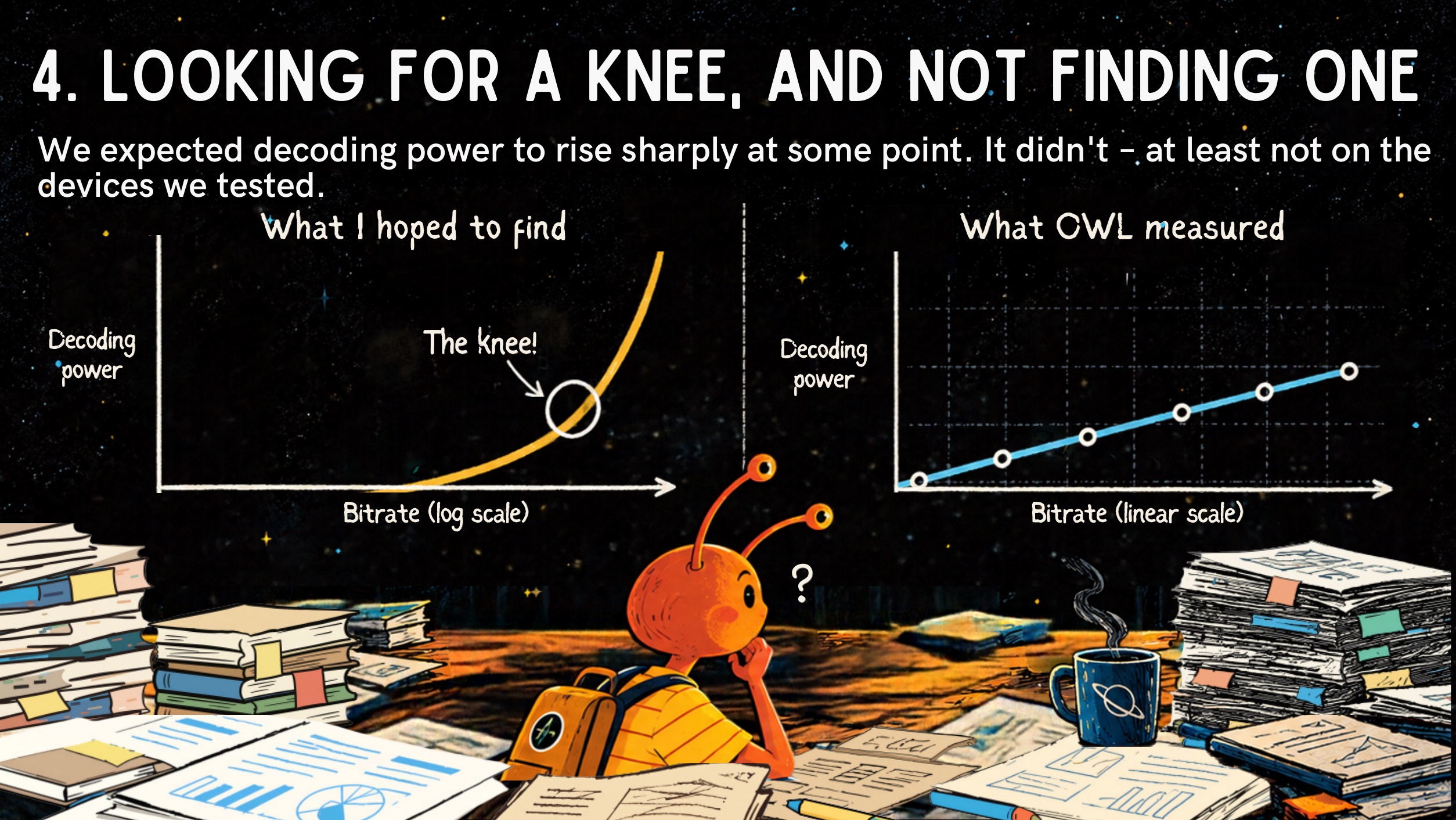
So the decoding-energy data won’t tell us where to stop. Although energy measurements reliably tell us what something costs, they can’t tell us whether it’s worth it.
That answer has to come from somewhere else. What does the viewer actually gain? Is this higher resolution visible on this screen, at this distance? On a phone? At what bitrate does additional data stop producing a perceptible improvement?
We can investigate that scientifically too, through viewing trials. There may well be a useful knee in the relationship between bitrate and perceived quality, even if there isn’t one in decoding power.
Following the money
If so much ingenuity has gone into the bits, it’s because that’s where the money is. Improving compression cuts the delivery bill benefiting the operator. But when a television uses 15% less electricity, the saving lands with the viewer. The streaming service never sees that bill, and a more efficient display does nothing for the CDN’s.
We’ve been doing our jobs, optimising the system where the benefits are easiest to measure, justify and monetise. That goes for Greening of Streaming too: measurement is not the point unless we keep checking that we’re measuring what matters.
Enough
In The Cost of Free, I argued that limits are productive and that engineers do their best work within them. Our industry’s history is one long, successful escape from limits. When bandwidth ran short, we improved compression, and when capacity ran short, we added infrastructure. We’ve become experts at asking “can we?” but still neophytes at “will anyone notice?”
I’m not arguing for worse pictures; that would be an odd position after spending a large part of my career improving them. But a brighter picture isn’t always a better one; more pixels aren’t always visible, and the cleverest codec isn’t always the most energy-efficient.
We can now measure the watts. We can also measure what viewers actually perceive, although that’s considerably harder. What we still struggle with is deciding when an improvement is worth the resources it requires.
I don’t know where that threshold lies for a football final on a 75-inch OLED, or for a teenager watching the same match on a phone. There probably isn’t a single answer. I do believe that if and when an energy-saving mode is available, it should be the default, with a gold button option for special occasions, not the other way around with a green button, but that’s a story for another article.
After decades helping this industry get past its limits, I’m starting to think that working out where to put them is the more interesting engineering problem.
Tell me where I’ve got it wrong.
This essay was first published on my Substack, benschwarz2.substack.com, where you can subscribe for new pieces.