
A personal essay on unlimited data, false freedom, and learning to feel limits again
A note before you start. This is a personal essay. It is not a Greening of Streaming position, and nothing in it should be read as GoS policy. It is the product of about a year spent trying to connect two parts of my life that refused to share a room: the measurement work I do on streaming and telecom energy, and my growing involvement with the regenerative movement through the With-Life community. Along the way, I circulated earlier drafts to friends and colleagues, and several of them took the argument apart with real care. Some disagreed with me sharply. I have kept their objections in, with attribution, because the disagreement turned out to be the most valuable thing here. Where they changed my mind, I say so. Where I still hold my ground, I say that too.
Limits are not the opposite of freedom
Start with a memory almost every parent shares. There is that unpleasant moment when you have to set a limit on a child’s behaviour, and they rebel. Then, a little later, something odd happens. The child radiates a kind of pride and contentment, a settledness that was not there before. The frustration of the limit turned into something like relief. The boundary, imposed from outside, became a place to stand.
I have come to think this pattern runs deeper than parenting. Unlimited space is not obviously a gift. There is no way to satisfy our deepest desires in a space without edges: the objective is always just beyond the horizon, and the people chasing it hardest never seem to arrive. An unlimited field is not freedom. It is a low, permanent anxiety.
The opposite move, accepting a limit, is what the French call dépassement de soi, a going beyond oneself. Constraint is where creativity actually lives. Sarah DeWitt, reading an early draft, pointed out that the same holds for teams: establishing constraints is often what ignites performance rather than dampening it. A colleague from nRhythm made the case from the direction of the living world, pointing me to Allan Savory’s holistic management, where the health of brittle grasslands depends not on letting animals roam without limit but on concentrated, well-timed disturbance. The small proofs are everywhere: the forty-eight-hour film festival, Inktober, the haiku. None of them would produce anything without the boundary. The boundary is the engine.
Our own bodies work this way. We eat, then we are full. We stay awake, then we must sleep. The limits are not punishments. They are the shape of being alive. Which raises an uncomfortable question about the one part of modern life we have deliberately built to have no felt limits at all: our connection to the network.
The seduction of the unlimited
« Unlimited » is a beautiful word. It is bound up with a deep, half-romantic desire to roam, to discover, to be free in an open space. It is the pull of the Western, the empty horizon, the road that never ends. It is also, in its shadow form, the temptation to behave without restraint: the person playing a video out loud in a train carriage without headphones, a small demon of the unbounded self.
Most of us meet the unlimited in a more banal place: the phone that will not stop asking for money. You fill your iCloud storage, try a few times to delete the oversized videos, give up, and pay the ninety-nine cents, or the ninety-nine of whatever, to make the problem disappear. The limit was real. We just bought our way out of feeling it. That is the whole business model of the unlimited: not the removal of limits, but the removal of the feeling of them.
Here is how that feels from the inside, and it is worth slowing down for:
You reach for your device. It wakes instantly. Of course it does: the network is always ready.
Your stream starts in seconds. Your apps sync in the background. Everything just works.
But what if it didn’t? What if, instead of consuming invisibly, you saw your data balance tick down, or got a small nudge: this stream is coming from a server fifteen thousand kilometres away, running on fossil fuel?
What if every gigabyte were not « unlimited » but visible, finite, shared? Would you hesitate? Would you scroll less? Stream less?
Today, you don’t have to think about it. That is the point. Flat-rate plans help decouple digital actions from physical consequences. No prompts. No trade-offs. No feedback.
That word, feedback, is where this essay was supposed to go, and it is also where my colleagues stopped me. So let me tell it in that order: first, the argument I set out to make, then what happened when people who know more than I do got hold of it.
The argument I set out to make
I have been a Green Party member most of my life. For the past five years, I have worked in digital sustainability. I now lead the Greening of Streaming initiative and advise companies on reducing the environmental impact of streaming and telecom infrastructure. Over the past year, I have also been exploring regenerative design with the With-Life community. That has been a genuine shift in how I see things. Two of its ideas matter most here: first, that the operating principles of human society have drifted almost entirely away from the principles that govern Life itself, and second, that the technology worth keeping in a good future should not merely avoid harm but actively help life along.
My starting thesis was simple, maybe too simple. Unlimited data plans, introduced decades ago, promised ease and freedom and became the industry norm. They came, I argued, with a hidden cost: over the years, they shaped how networks are built. Flat-rate plans mean you pay for access rather than for what you use. Watch two hours of video a day or twenty, you are billed the same. That decoupling of consumption from consequence, I thought, had quietly influenced network design, encouraging operators to provision for a fantasy of infinite headroom and then keep everything running hot, just in case.
Andrew Ladbrook, a Londoner, gave me a good illustration. Earlier last year, Londoners were indignant to discover that phones showing a « 5G » logo were often connected to older 4G networks [15]. The outrage was not really about measured performance. It was about trust, and about the latent promise of always-on, limitless capacity that we have been trained to expect. We may not need 5G every second, but we want to know it is there. That expectation, I argued, shapes how networks get built: provisioned for the potential, not the actual, and therefore kept powered even when barely used.
From there, my argument almost wrote itself. Flat pricing breaks the feedback loop between what we do and what it costs the world. When something feels free, we do not use less, we use more. Behavioural economics even has a name for part of this: the flat-rate bias, our documented tendency to prefer flat rates even when pay-per-use would save us money, because predictability is comforting [12]. So, I concluded, reintroduce a mild feedback loop. Let a bill vary by 10% with usage. Nudge people, and, more importantly, nudge network designers toward systems that respond to real demand. Back it with regulation, because voluntary change will be too slow. Call the result a first step toward regenerative network design.
It is a tidy argument. I believed it. And the people I most respect in this field spent a lot of ink explaining why large parts of it are wrong.
But before I let them, I owe you a confession that took me most of a year to reach. I was making two arguments and mistaking them for one. The first was an energy argument: unlimited plans make us waste power, so we ought to feel the cost. The second was quieter, and I had buried it under the first: that a life engineered to feel unlimited, with no edges, no feedback, no sense of enough, costs us something real even when it costs the grid nothing. The first argument turned out to be far shakier than I thought. The second is the reason I am still writing. So let me deal with the first honestly and quickly, because clearing it out of the way is exactly what let me finally see the second.
The corrections, quickly
Rudolf van der Berg read an early draft with an economist’s and an engineer’s eye, and Dom Robinson, who founded Greening of Streaming, read it with three decades of network scars. Between them, they took the energy argument apart. Four corrections matter. I am compressing them here, not hiding them: the fuller version is in the notes at the back, and so is the credit.
One. A network’s energy is set by the capacity it is provisioned for, not by the traffic flowing through it. Rudolf put the physics plainly, reaching all the way back to Lord Kelvin, who could not make a transatlantic telegraph respond to load but could make the link itself dramatically more efficient. The measured numbers are stark: a widely used core router draws about 755 watts idle and about 770 at three-quarters load, a two per cent difference between near-idle and busy [4]. The network is built to run hot, and it runs hot whether you stream or sleep. This confirms the dramatic half of my thesis and quietly destroys the useful half. If energy follows provisioned capacity, a person streaming less saves almost nothing. As Dom put it, cutting data on a network built to run around the clock is like taking cars off the road and expecting the tarmac to shrink.
Two. The lever is not in the consumer’s hand. You do not really pay for usage, Rudolf pointed out. You pay to be connected, and what sizes a network is your contribution to the peak hour, not your monthly total. The things that actually move energy, the bitrate, the codec, the idle monitoring left running, the efficiency of the servers, all sit with the service designer and the operator. Charging me by the gigabyte makes me feel responsible for a lever I cannot reach. Hold on to that phrase. It matters later.
Three. I had insulted the wrong thing. What I lazily called the dumb pipe is really the end-to-end principle, one of the internet’s founding design choices: keep the intelligence at the edges and let the network do nothing but route. Dom was firm about this, and he is right. That discipline is precisely why the internet scales. The pipe is not dumb. It is disciplined. Remember that too.
Four. If you want change, aim at the operators, not the users. The measured savings from clever consumer-facing tricks are tiny: one continental mobile trial saved around seventy kilowatts, roughly seventy domestic fridges, against a network measured in terawatts. The real leverage is unglamorous and entirely on the supply side. Provision to actual need rather than to a fantasy of infinite headroom. Retire legacy copper and old radio generations aggressively, which is where Europe’s real energy reductions have come from. Design services frugally. Power what remains renewably. Dom’s version of the incentive is cleaner than the one I had dressed up: stop chasing the consumer’s few cents and move the cost of non-renewable energy onto the operators, where it is easy to measure, easy to audit, and impossible to ignore.
All four corrections point the same way: my lever was aimed at the wrong target. There is one knot inside that I have not untied, and I would like to give it an essay of its own someday. If my own restraint changes the network’s energy by nothing measurable, and yet the capacity that sets that energy is only the sum of all our demands at the busy hour, then the individual lever is both real and vanishing at once. Real, as one share of the collective peak that decides what gets built and powered. Vanishing, because no single share moves the provisioning, and because the equipment draws near-peak power whether it is busy or idle. That is a genuine paradox, not a rhetorical flourish, and it is exactly the kind of boundary problem I spend my working days inside.
I set it down here rather than solve it because clearing the energy argument away revealed what my discomfort had been about all along: it was never really kilowatts.
The part that was never really about kilowatts
So why keep the personal, human thread at all if the consumer cannot save the network? Because I no longer think that thread was ever about energy. It was smuggling itself in as one, and that was its weakness. It is something else that survives on its own terms.
The feeling of the unlimited, the frictionless, consequence-free, always-on connection does something to us that has nothing to do with terawatts. It severs the small daily relationship between an action and its cost in the world. That severance is comfortable, and it is also, I think, part of why so many of us feel vaguely unwell in our connected lives. This is the terrain the sufficiency thinkers have been mapping for years. The idea of digital sufficiency, carefully set out by Santarius and colleagues, distinguishes among hardware, software, user, and economic dimensions and treats the point not as deprivation but as an absolute reduction in resource use while maintaining or even improving the good life [2]. The French discourse on sobriété numérique, carried by the Shift Project and by Frédéric Bordage, makes a similar move: not a guilt trip about watching one fewer video, but a change in our whole relationship to the tools [3].
More plainly, the one thing available to almost all of us, in a connected life we are not going to abandon, is to restore a felt relationship with limit. Not because my restraint measurably cools a data centre. It does not. But because living as though everything is unlimited is a kind of quiet lie about the world, and lies have costs that do not show up on an electricity bill. The regenerative movement’s first move is to notice that human systems have lost any resemblance to living ones. Living systems have edges, cycles, feedback, and enough. A life spent inside an interface engineered to feel edgeless, cycleless, feedbackless, and never enough is a life pulled a little further from the living world every day.
This is also why I keep a soft spot for small, imperfect gestures like DotDot, the French device that lets people share mobile data locally and feel the gigabyte again as something finite and shared [16]. Dom and Rudolf were right that it saves nothing that a phone’s own hotspot could not. But the value I saw in it was never the energy. It was the reminder, held in the hand, that access is not free and never was.
Where Dom and I still disagree
My instinct is that true digital freedom comes not from boundless consumption but from conscious connection: that the limit is part of the point. Dom does not quite agree. For him, consciousness can perfectly well come from boundless connection, as long as the availability of that connection is powered renewably. In his view, the problem is not boundlessness; it is fossil fuel. Fix the energy source, and the moral weight of the unlimited largely dissolves.
I find that I cannot fully refute him, and that this is the most useful sentence in the essay. He may be right that my attachment to limit is temperamental, even a little romantic, a Green Party childhood showing through. Or I may be right that a life without felt edges costs us something that clean electrons cannot repay. Probably we are each partly right, about different things: he about the network, me about the person. That is roughly where a year of thinking has left me, and it is a more honest place than the one I began in.
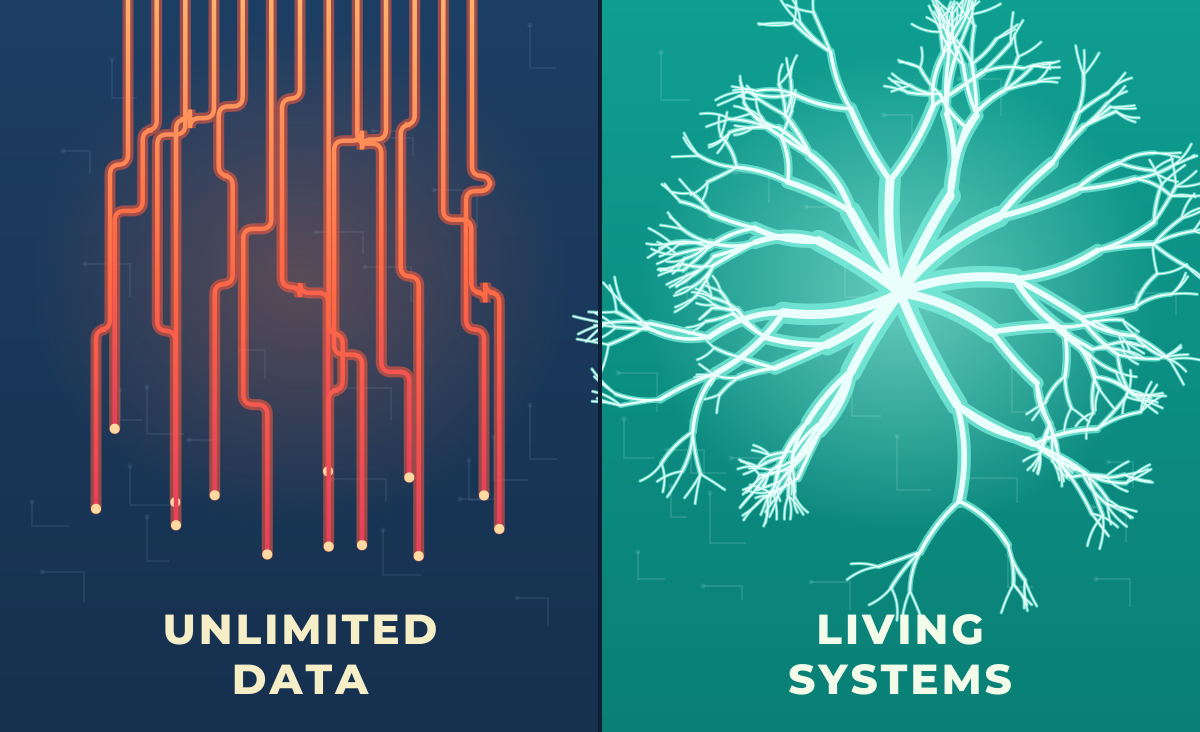
There used to be a line under the picture at the top that read “from dumb pipes to living systems”, which I took as an instruction to make the pipes clever. I had it backwards and removed the line. The pipes should stay disciplined. That discipline is their virtue, and it is greener than any cleverness I could bolt on. The living system that needs rebuilding is not the network. It is us: the people who design these systems, provision them, regulate them, and spend our days inside them, and who have quietly forgotten what edges, cycles, feedback, and enough are for.
Limiting data may never have been the lever that saves the grid. Rudolf and Dom convinced me of that, and I am glad they did. But unlimitedness is still a design choice, and it trains us, gently and constantly, to live without limits: to expect no friction, feel no consequence, and never arrive at enough. That is the real cost of free. It just never shows up on the bill.
— B.S.
Afterword: one small thing I would still try
Having more or less talked myself out of my own policy idea in this essay, let me state what I can’t quite let go of in a more direct way. I would still like regulators to consider a little variability in consumer contracts: a band of, say, plus or minus ten per cent, so that some months I would notice I had used more, and other months less. Not a meter that punishes, just a small, regular reminder that the thing I am using has a shape, and edges, and is shared by everyone else drawing on it.
I can hear the objections. Rudolf will again tell me, correctly, that this saves no energy and mostly builds a billing database that nobody needs, and correction two still stands: I would feel responsible for a lever I cannot reach. As I made clear, I am not saying this cools a data centre; it does not. I am saying something smaller and, to me, more important: that a monthly nudge toward the finite is a way of practising a relationship with limit, in the one corner of modern life we have most thoroughly built to feel limitless. If, over the years and at scale, it also gave operators a reason to care about shaping the peak, I would be glad. But I hold that last hope loosely, and my own essay is the reason why.
Appendix: fuller notes on the four corrections
The essay compresses the technical argument to keep the human thread in view. For anyone who wants the detail I moved out of the way, here it is.
The edge server I cast as a villain is often the opposite. My draft imagined a local cache « always on, always drawing full power ». Rudolf pointed out that this is roughly backwards. Netflix designs its Open Connect caches to be strikingly frugal, and the economic logic of a content delivery network already places content close to viewers, which saves the provider, the ISP, and the planet at once [7]. The optimisation I was calling for is, in large part, already the business model.
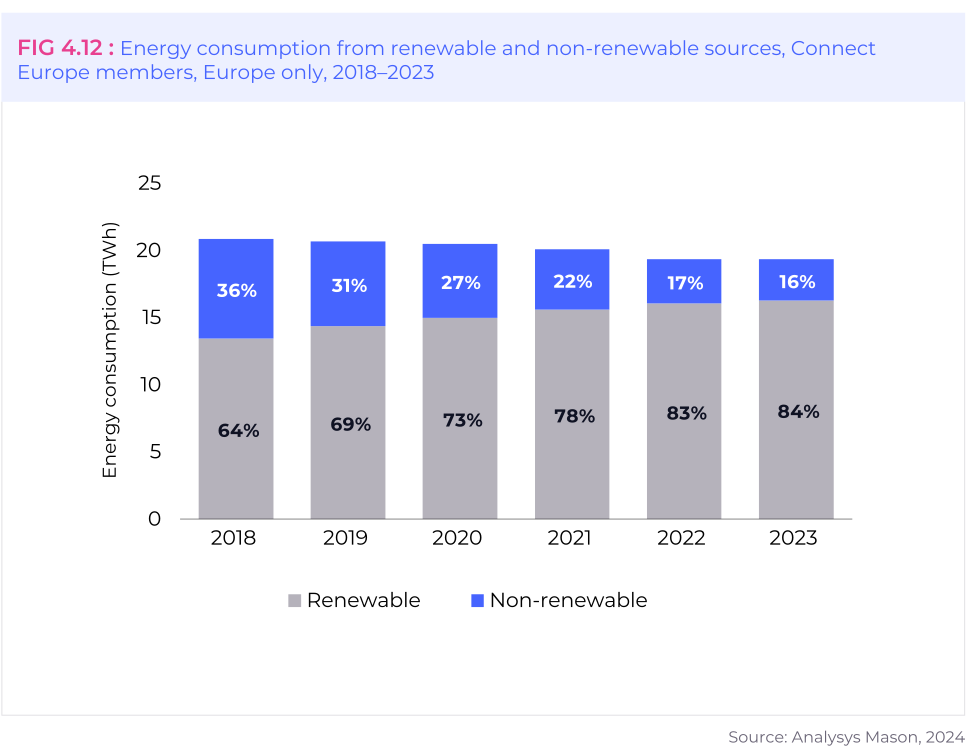
In Europe, the numbers point the other way. My headline had the sector’s footprint « growing, fast ». In mature markets, it is decoupling and often falling, driven by decommissioning copper, PSTN, and older radio generations, and by renewable procurement. In France, the fixed network’s energy has been decreasing; Rudolf’s Dutch example shows KPN using more than 45 per cent less than in 2012 [8][9][14].
Usage-based pricing has a sting in the tail. Rudolf’s verdict, which I think is right: metering everyone mostly produces enormous billing databases that are themselves a permanent cost and energy sink, to send people signals about a lever they cannot pull. Peak and off-peak broadband did exist, in Australia among other places, and has been quietly disappearing. I also note that the paper I cited on time-and-location pricing is theoretical rather than empirical and assumes that 5G base stations use more energy than 4G, which deployments generally do not show [11].
The « dumb pipe » argument was settled long ago. The end-to-end case I attribute to Dom has a lineage Rudolf reminded me of: David Isenberg made it in 1997 in « The Rise of the Stupid Network » [6], and Wired ran « Netheads versus Bellheads » the year before. The people who believed flat pricing had killed innovation were on the losing side of an old argument, and losing for good engineering reasons.
Further reading and references
Links and sources referenced above, plus a few adjacent pieces worth reading. This is a reading list, not an academic apparatus.
[1] On the rebound effect / Jevons paradox in digital: W. S. Jevons, The Coal Question (1865); and, for a readable modern take from inside the sector, Tom Greenwood, Are we trapped in the Jevons paradox? (Wholegrain Digital).
[2] Digital sufficiency: conceptual considerations for ICTs on a finite planet. Annals of Telecommunications (2023). The clearest framework I found for the sufficiency idea splits it into hardware, software, user and economic dimensions.
[3] The Shift Project, Lean ICT / Déployer la sobriété numérique; and Frédéric Bordage, GreenIT.fr. The core of the French sobriété numérique discourse.
[4] D. Mytton et al., Network energy use is not directly proportional to data volume, Journal of Industrial Ecology (2024); building on J. Malmodin (2020) and router benchmarking by Chabarek et al. (2008). The evidence is that network energy tracks provisioned capacity, not traffic.
[6] D. Isenberg, The Rise of the Stupid Network (1997), isen.com/stupid.html. The founding statement of the end-to-end case, and why the « dumb » pipe is a feature.
[7] Netflix Technology Blog, on the energy efficiency of Open Connect appliances. How a CDN cache is designed to be frugal.
[8] Connect Europe (formerly ETNO), The State of Digital Communications. Source of the chart above on European members’ falling energy use and rising renewable share.
[9] European Commission Joint Research Centre, common indicators for the environmental footprint of electronic communications networks (2024); and ARCEP data on fixed and mobile network energy in France.
[10] McKinsey, The growing imperative of energy optimisation for telco networks (2023).
[11] Time- and location-aware pricing model, arXiv:2303.06529. Cited with a caveat: it is theoretical, not empirical, and assumes 5G base stations use more energy than 4G.
[12] A. Lambrecht and B. Skiera, Paying Too Much and Being Happy About It, Journal of Marketing Research (2006). On the flat-rate bias.
[13] A. Savory, Holistic Management; Savory Institute. The regenerative-grazing source behind the constraint-and-disturbance idea, via nRhythm.
[15] London Centric, on the 5G-logo controversy (2025). Andrew Ladbrook’s example.
[16] DotDot / shareyourgbs.com, and Project Exigence (projectexigence.eu), source of the prize-draw idea for pooling small data savings.
Contributors whose input is woven into this essay
With thanks. Inclusion here means a specific point of theirs shaped the text; it does not imply they agree with the essay, and several emphatically do not.
Rudolf van der Berg. The essay’s central corrections: consumers pay to be connected rather than for usage; the meaningful feedback loop belongs to the service designer and operator, not the user; network energy is set by transmit power and distance, not by traffic (the Lord Kelvin example); the European and French energy figures are decoupling or falling (KPN down 45% since 2012); the CDN model, and Netflix Open Connect, already do the optimisation I called for; usage-based pricing mostly builds wasteful billing databases; the end-to-end lineage via Isenberg; the caveat on the time-and-location pricing paper; the mobile-data-share and Wi-Fi nuance; and the fair methodological warning about invoking behavioural economics without the right loop.
Dom Robinson. The end-to-end principle correction (the pipe is disciplined, not dumb); the proportionality argument, including the Vodafone « seventy fridges » figure and the risk of adding more energy through AI or P2P « intelligence » than we save; the tarmac-and-cars framing of why consumption savings do not shrink a hot network; the case for moving energy cost onto enterprise rather than consumers, which became the BEREC incentive idea; the sceptical read of DotDot; and the closing counter-position, that consciousness can come from boundless connection if it is powered renewably.
Sarah DeWitt. The observation that establishing constraints is what ignites performance is extended here from teams to the essay’s opening argument about limits.
nRhythm. Allan Savory’s holistic management and the role of bounded, concentrated disturbance in brittle ecosystems; the body-as-constraint framing; and the creativity-from-constraint examples (the 48-hour film festival, Inktober, the haiku).
Andrew Ladbrook. The London 5G-logo example illustrates how the latent promise of always-on capacity shapes expectations and, in turn, network provisioning.
Barbara Lange and Stan Moote also gave generous feedback on earlier drafts, which shaped the essay’s overall direction even where no single line can be pinned to them.